
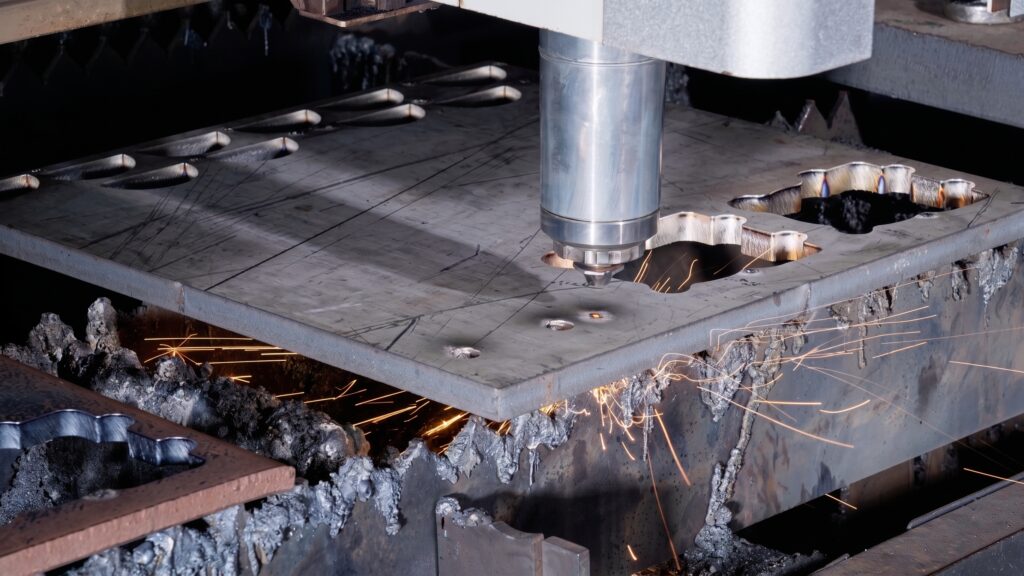
Cutting ultra-thick metal (more than 60 mm) on high-power 30 kW fiber laser machines is a task that requires not only high power, but also careful preparation of the entire optical path and the correct cutting strategy. Just setting the maximum power is not enough-it is critically important to take into account the physics of interaction of the laser beam with a thick material.
For Ukrainian manufacturers who switch to processing thick sheets (for example, for heavy engineering, shipbuilding or building structures), proper preparation of the machine allows not only to achieve a stable result, but also to significantly reduce the cost of the part.
Below is a detailed engineer’s checklist for preparing the 30 kW Bodor laser metal cutting machine for cutting ultra-thick metal.
Optical path adjustment: focus and beam quality
the main tool of an engineer when working with thick metal is focus control. For super-thick materials, the rule applies: at the beginning of cutting, you need a positive focus in order to “flash” the material stably, and already in the process, to increase productivity, it is changed to a negative one – for better energy penetration into the melt.
What to check:
- lens quality. Make sure that the protective and focusing lenses are perfectly clean (no cracks or burn points). Even microparticles distort the beam.
- Head calibration. Calibrate the position of the Z-axis and the height sensor. For thick metal, the stability of the gap support (standoff) is important — no more than 0.5–1.0 mm.
- Focus positioning. For a stable cutting start, set a positive focus (for example, +25…+30 mm for 60 mm steel). After passing through the top layer, change to negative (for example, -25 mm) to increase the penetration efficiency.
Auxiliary gas selection
For ultra-thick carbon steel, oxygen (O₂) is the standard choice, as the exothermic reaction adds energy, which is critical for deep cutting. For stainless steel, nitrogen (N₂) is used for a clean cut without edge oxidation, but is prepared for a lower speed compared to oxygen.
What to check:
- gas pressure and purity. Make sure that the oxygen pressure is stable and corresponds to the flow chart for the given thickness.
- Nozzle status. Inspect the nozzle for deformations and slag buildup. For thick metal, use nozzles with a large diameter (for example, 3.0-4.0 mm for oxygen).
- Replacement of gas filters. Make sure that the filters are not clogged.
Recommended initial cutting parameters (30 kW)
based on the official Bodor Laser guides, here are the recommended initial settings:
| material and thickness | Gas | Initial speed | Focus | power | gas pressure | nozzle diameter |
|---|---|---|---|---|---|---|
| carbon steel (60 mm) | oxygen | Lower Range limit | positive (for starting) | ~22 kW | map | 2.4-3.0 mm |
| carbon steel (60 | oxygen | Lower Range Limit | negative (after start-up) | ~22 kW | map | 2.4-3.0 mm |
| Carbon steel (30 mm) | oxygen | Lower Range Limit | -15 mm (half thickness) | ~22 kW | ~1.8 bar | single-layer, 2.4 or 3.0 mm |
| carbon steel (20 mm) | map air | Map | by map | ~11 bar | map by map | |
| stainless steel (20 mm) | Nitrogen | on the map | 1/3-1/2 thickness | on the map | on the map | on the map |
| stainless steel (40 mm) | air | on the map | on the map | on the map | on the map | on the map |
Cooling system and thermal stabilization
when operating at a power of 30 kW, the load on the cooling system (chiller) becomes critical. Overheating of the optics or laser source will cause an emergency stop.
What to check:
- temperature of the liquid. Make sure that the inlet coolant temperature is set between 21-25 °C with an accuracy of ±1 °C. A deviation of more than 2 °C significantly reduces the power and resource of the source.
- Level and cleanliness. Check the liquid level in the tank and the cleanliness of the chiller filters.
- Thermostabilization. Ensure normal operation of the thermal stabilization system to avoid focus drift during prolonged operation.
Mechanical part: guides and drives
increased weight and vibrations when working with thick metal require an ideal condition of the machine’s mechanical components.
What to check:
- the lubrication system. Make sure that the guides and rails are lubricated (operating level and free of contamination). For such loads, PAO-based lubricants witha viscosity of ISO VG 68-100 are recommended.
- Backlashes. Check that there is no backlash in the gearboxes and gears of the drives.
Process start
-up before cutting a batch, perform a test run:
- Start-up of equipment. Start the systems in the correct sequence: stabilizer → compressor → gas line → chiller → laser source → control system.
- Homing. Be sure to output the axes to zero points (homing).
- A test item. Start cutting a part with a simple geometry to check the quality of penetration and the absence of slag on the bottom edge.
Compliance with this preparation sequence reduces the risk of defects and downtime when switching to serial cutting of ultra-thick metal — and allows you to fully unlock the potential of a 30 kW fiber laser.