
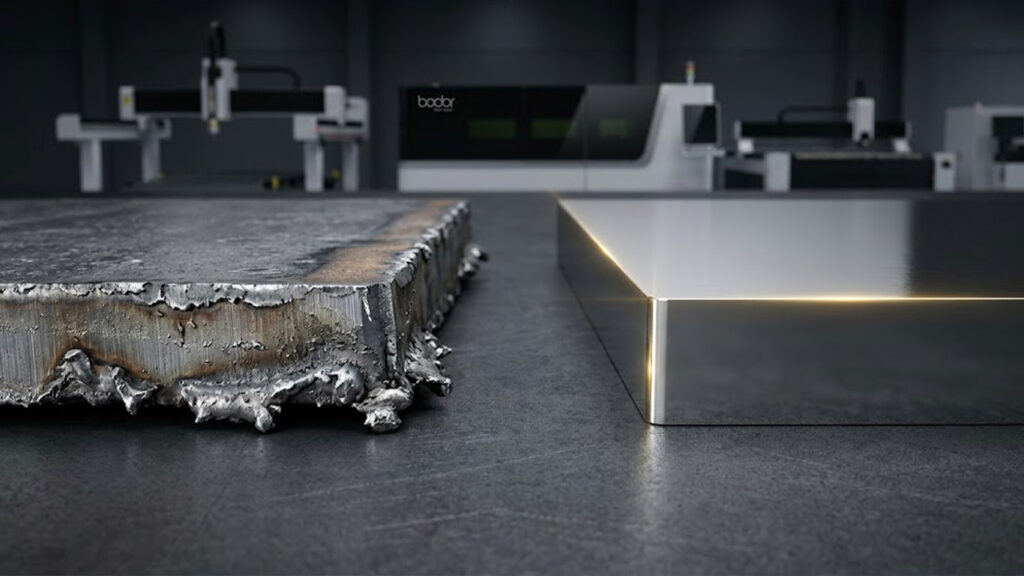
Bodor fiber lasers vs plasma cutting: 4 practical reasons to upgrade the workshop
plasma cutting has remained the standard for metalworking companies for decades. However, with the development of fiber laser technologies, the situation has changed dramatically. Today, even small workshops are increasingly choosing laser over plasma-and for good reason.
In this article, we will look at 4 practical reasons why Bodor fiber lasers are a profitable alternative to plasma cutting for Ukrainian manufacturers. These are not only marketing arguments, but also real technical and economic advantages that directly affect the cost of production and the competitiveness of the enterprise.
Reason 1: Cutting width-precision that saves metal
One of the biggest differences between a laser and a plasma is the cutting width. Plasma cutting leaves a wide slot (usually 3-5 mm), which leads to significant material losses, especially when cutting expensive metals or small complex parts.
Bodor fiber lasers provide ultra-precise cutting widths of just 0.1-0.3 mm, allowing you to:
- save metal: less waste, more dense layout of parts on the sheet (Nesting).
- Reduce production costs: critical when working with stainless steel, aluminum, and copper.
- Ensure a clean edge: laser cutting does not require additional processing, whereas after plasma, a long grating removal and grinding are required.
For an enterprise that processes 10 tons of metal every month, savings on cutting width and layout density reach 5-7% of the material. In monetary terms, this is tens of thousands of hryvnias per month.
Reason 2: Flashing small holes is something that plasma can’t do
Plasma cutting has a significant technological limitation: the impossibility of high-quality stitching of holes whose diameter is less than the thickness of the metal. For example, for a sheet with a thickness of 10 mm, plasma cannot penetrate a hole with a diameter of 6-8 mm without deforming the edge or taper.
The Bodor fiber laser solves this problem:
- Stitching holes from 1 mm -regardless of the thickness of the metal (the ratio of diameter to thickness can be 1:1 or less).
- No deformations: the laser beam does not create mechanical pressure and has a minimal thermal impact zone.
- No additional drilling required: save time, equipment, and salary.
This is critical for the production of parts with a large number of holes — flanges, brackets, perforated panels and elements of metal structures.
Reason 3: Processing of sharp corners and complex contours
plasma cutting tends to round corners and form deposits (slag) on the lower edge. This requires additional locksmithing and reduces the accuracy of parts.
Bodor fiber lasers provide:
- perfectly sharp corners – without rounding or burning.
- High positioning accuracy -up to ±0.03-0.05 mm.
- Clean edge -free of slag and surfacing.
- Minimum heat exposure zone (HAZ) — the part does not warp from heating.
This allows you to produce parts that are immediately ready for welding or assembly, which significantly reduces the overall production cycle.
Reason 4: economy of ownership-laser pays off faster
many entrepreneurs believe that plasma is cheaper due to the lower initial cost of the machine. But this is an illusion if you estimate the total cost of ownership (TCO) and the cost of a single part.
| Parameter | plasma cutting | Bodor fiber laser |
|---|---|---|
| Cutting width | 3-5 mm | 0.1-0.3 mm |
| cutting speed (up to 12 mm) | medium | high (2-4 times faster) |
| edge quality | requires processing | Ready-to-use |
| insertion of small holes | is not possible | yes (from 1 mm) |
| consumables | frequent replacement of nozzles / electrodes | long service life of optics and nozzles |
| energy efficiency | low efficiency | high (fiber source efficiency > 40%) |
| average payback | period- | 1.5-2 years |
additional economic advantages of the Bodor laser:
- reduction of labor intensity: minimization of manual labor and locksmith processing.
- Reduced reject rate: stable quality of every part thanks to the BodorThinker CNC.
- High autonomy: ability to integrate automatic exchange tables and loaders.
According to Bodor Laser’s operational data, switching from plasma cutting to fiber laser can reduce the cost of the finished part by 20-30% in the first year of operation.
Time to modernize the shop
plasma cutting has fulfilled its historical role, but today it is inferior to fiber lasers in all key parameters:
- accuracy: the laser cuts cleaner, faster and without deformations.
- Savings: less metal waste, lower electricity consumption.
- Versatility: stitching small holes, complex contours, any metals.
- Payback period: fast payback due to high performance.
If your company still runs on plasma, it’s time to think about upgrading production. Bodor Laser fiber lasers are not just equipment, but an investment in stable margins of your business for years to come.
Need advice on Bodor Laser equipment in Ukraine?contact your official representative: